
The Hidden Costs of Over-Engineered Sound Systems
When evaluating a commercial audio proposal, flashy digital specs often hide a costly reality: fragile networks, abandoned software, and endless staff retraining. Before signing off on an over-engineered setup, decision-makers must calculate the hidden operational expenses that show up long after installation. At their core, an analog modular setup and a complex networked digital system accomplish the exact same goal: routing an audio source to speakers at a controllable volume. Yet, how the industry achieves that simple task has split into two completely different philosophies.
Why Over-Engineered Network Audio is Ruining Commercial Sound Design
At their core, an analog modular setup and a complex networked audio system can do the exact same thing: they can take an audio source—like a microphone or a phone playing music—and output it to speakers at a controllable volume.
Yet, how the industry achieves that basic task has split into two completely different philosophies:
Method 1: The Bulletproof Analog Standard
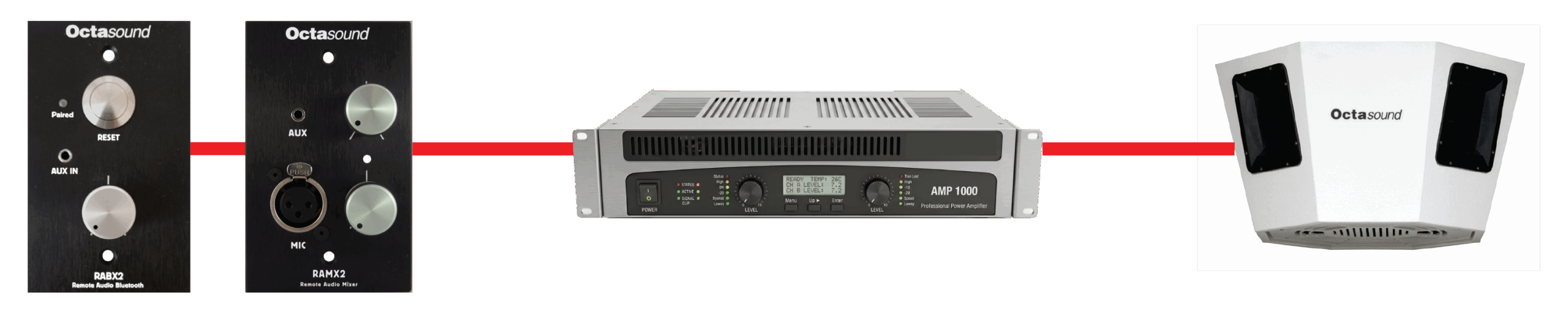
You take the amplifier inputs and extend them directly to modular wall plates (like the RAMX2 and RABX2) equipped with physical volume controls.
- The Workflow: A user plugs in a media player or microphone, or pairs via Bluetooth, turns a physical dial, and sound comes out.
- The Reality: It just works. There is no boot time, no firmware to update, no operating system to crash, and no network dependencies. If the building has electrical power, the sound system is operational.
Method 2: The Networked Digital Ecosystem – Cracking a walnut with a sledgehammer
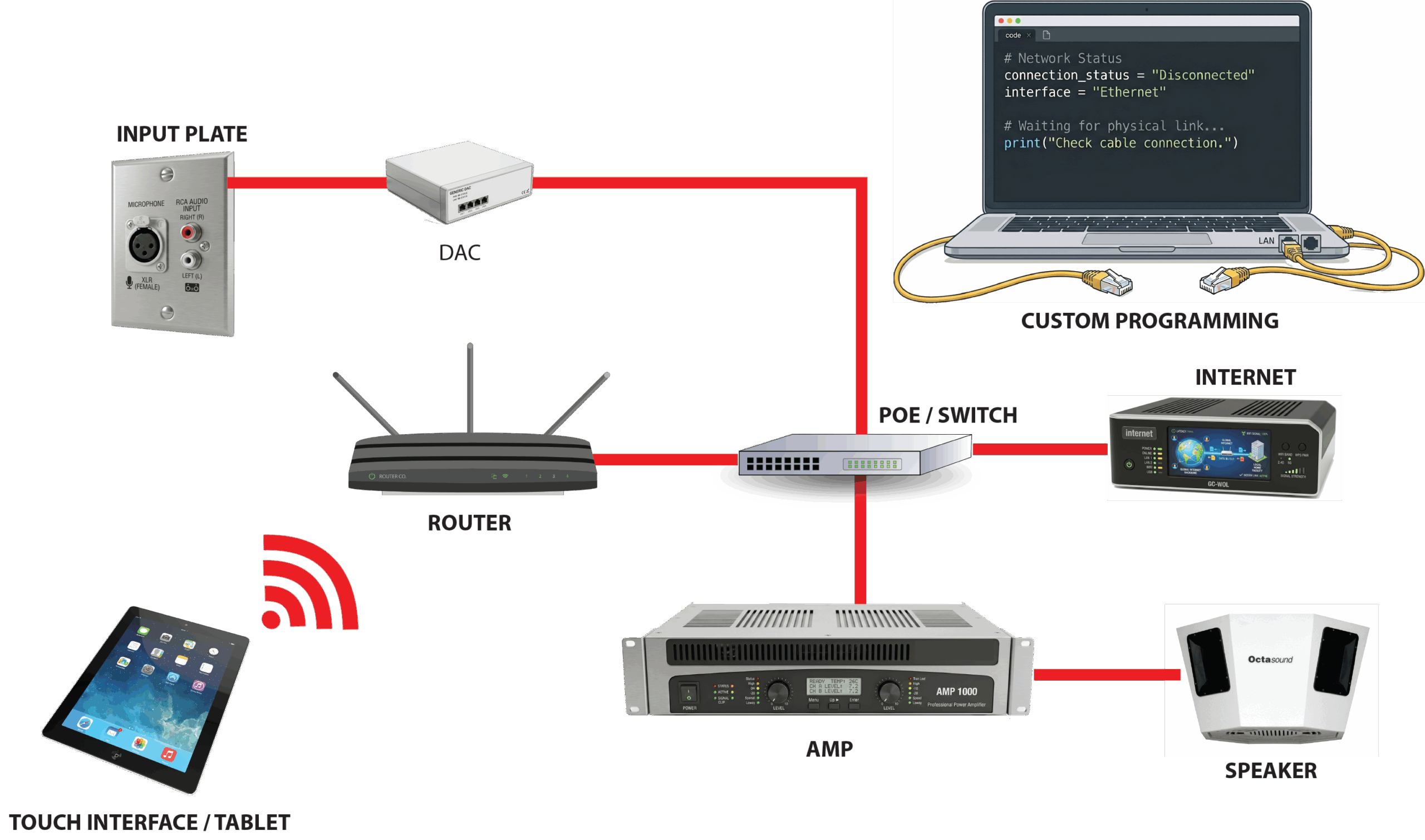
To achieve that exact same result, audio is digitized with a DAC to travel over Cat5/6 cabling, routed through Power-over-Ethernet (PoE) network switches, connected to a router, modem and amplifier, then programmed to be managed wirelessly over Wi-Fi via a control tablet, and then processed through digital control software.
- The Reality: You trade a physical volume dial for a multi-node chain where every single hardware piece, wireless link, and software layer becomes a potential point of failure.
Buy Efficiency, Not Liability
In the real world, if you are designing an audio system for all skill levels—a part-time student worker, a fitness instructor in a rush to start a class, a guest speaker, or the night-shift cleaning crew.
The Golden Rule: If operating a microphone or playing music requires an instruction manual, an onboarding session, or a call to tech support, the design has completely failed these users.
When you purchase an overly complex, feature-heavy digital network, you aren’t buying efficiency; you are buying a permanent training liability. Managers end up spending valuable time constantly retraining new staff or troubleshooting simple software errors.
Real-World Trade-Offs
| Feature | Modular Analog (RAMX2 / RABX2) | Networked Digital Ecosystem |
| End-User Learning Curve | Low – Turn a physical dial | High – End Users must be shown how to Navigate the app etc. |
| Points of Failure | Minimal (Physical wiring & amp) | High (Switch, Router, AP, Tablet, OS, App) |
| Interface Maintenance | Zero (No software/OS layer) | High (Software, Firmware Kiosk profiles, Operating Systems Etc. |
| Staff Training Liability | None (Universally understood) | High (Continuous onboarding for staff) |
| System Boot Time | Ready to Go – Instantaneous | Can be several minutes. Everything has to work. |
| Expected Lifespan | 15 to 20+ years | 5 to 7 years (Software/hardware obsolescence) |
Count the Real Costs—Demand Octasound
When you are offered a networked audio solution, look past the initial feature list and consider the day-to-day reality for your end users. Calculate your true exposure to discontinued software, obsolete hardware, and system downtime—these operational headaches represent real, recurring costs. Demand a design built for total, permanent reliability. Ask your contractor to quote Octasound, or give us a call today to for a system that simply works.